Splatchat
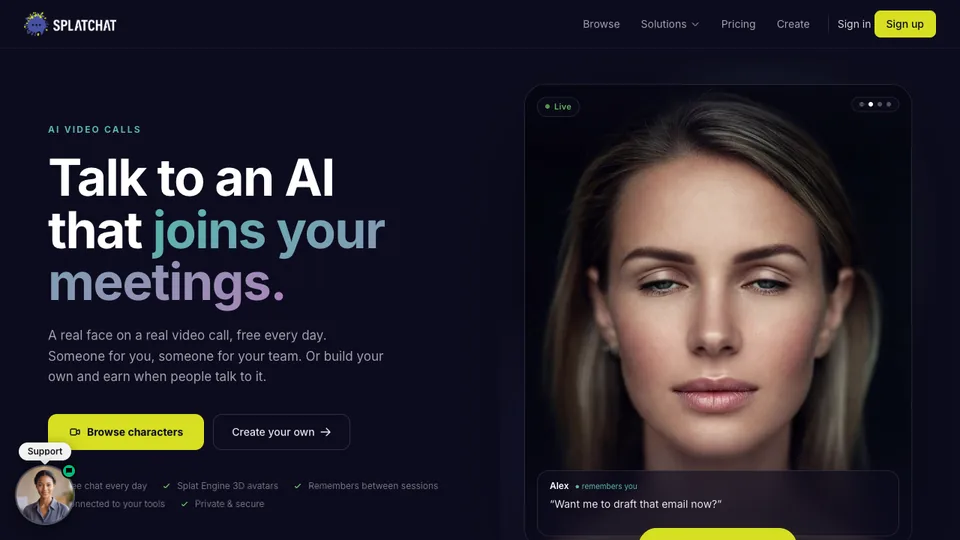
Splatchat started as homework. A few people on the Adwave team were poking at real-time AI avatars. I wanted to understand the pieces, not nod along in meetings, so I built a small thing on the side.
The question was simple: what if the person on the other end of a video call wasn’t human?
Shipping is how I learn, so I kept going. The exercise became a prototype, the prototype became something I wanted other people to try, and that became Splatchat.
You video-chat with an AI character. They look at you, react, and speak in real time. Not a chatbot with a face taped on. Pick from a roster, or make your own from a photo, a voice, and a personality. Characters remember prior calls. They can see through your camera or your screen when you let them.
People use them in ways I didn’t plan for. Characters join Google Meet, Zoom, or Teams as a visible participant, take notes, send a summary. Connect Slack, Gmail, Notion, GitHub, Linear, a CRM, and they can draft the email or file the ticket while you’re talking. Phone calls. Live broadcasts. An embed on your site. Or you just talk.
The one that surprised me: cloning yourself. Your face, your voice, your context, in the meeting you couldn’t make.
There’s an API and an MCP server if you want a face on your own agents.
The learn-it project ended up more interesting than the thing I was supposed to be learning it for.
Try it: splatchat.com
Related: What Used to Take a Team.